AIMHI System Transition Analysis Project
When Communities Change EMS Systems, What Happens Next?
Across the country, communities are reconsidering how emergency medical services are organized, funded, and delivered. Some are bringing ambulance transportation into local government, while others are changing contractors, regionalizing services, or exploring new delivery models.
These decisions can affect patient care, workforce requirements, municipal budgets, taxpayer obligations, system capacity, and long-term sustainability. Yet after a transition occurs, one important question is rarely asked:
Did the change actually deliver what the community expected?
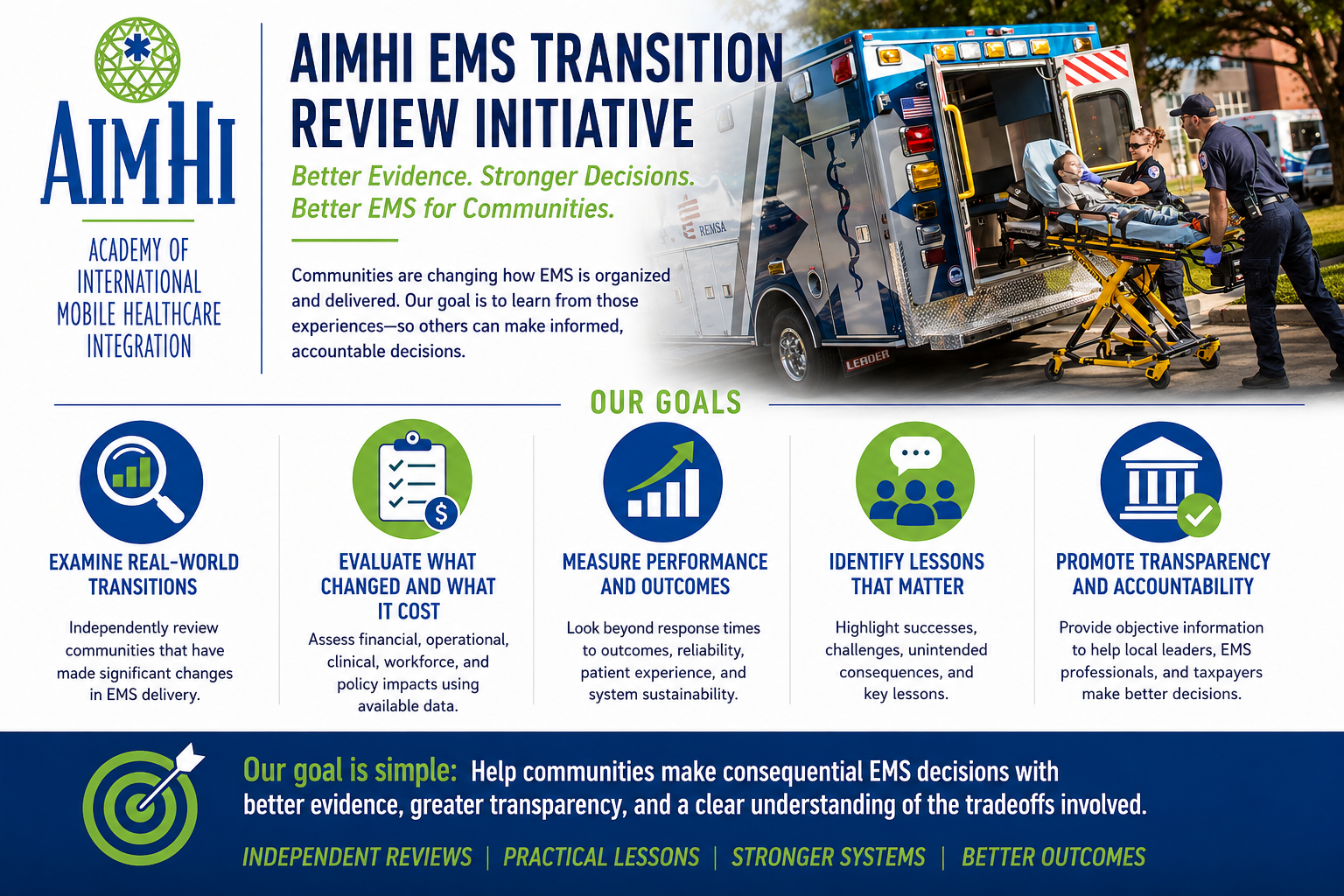
The Academy of International Mobile Healthcare Integration (AIMHI) EMS Transition Review Initiative was created to help answer that question.
Using data provided by communities through Freedom of Information Act (FOIA) filings, and publicly available information, when available, AIMHI is independently examining EMS transitions to evaluate what changed, what it cost, what benefits were realized, and what lessons can be learned.
The initiative begins with reviews of Flint, Michigan; Brattleboro, Vermont; and Burleson, Texas. These first three case studies highlight important lessons about EMS economics, workforce sustainability, performance measurement, transparency, and accountability.
The reviews are not intended to identify a “best” EMS delivery model. Fire departments, municipal agencies, private and nonprofit providers, regional systems, and public-private partnerships can all succeed when appropriately designed, funded, governed, and held accountable.
Instead, the initiative asks communities considering an EMS transition to focus on two fundamental questions:
Before the transition: What do we expect to gain, what will it realistically cost, and how will we measure success?
After the transition: What did we actually gain, what did it actually cost, and can we demonstrate that patients and the community are better off?
Ultimately, AIMHI believes communities considering major changes in EMS delivery should be able to learn from communities that have already made them.
AIMHI hopes these reviews will help communities make consequential EMS decisions with better evidence, greater transparency, and a clearer understanding of the tradeoffs involved.
Explore the Initiative
About the EMS Transition Review Initiative: Learn why AIMHI launched the initiative, how communities are selected and reviewed, and what the project is intended to accomplish.
Public Policy Lessons in Ambulance Service Transitions: An executive-level synthesis of the first three reviews, including comparative financial findings and eight public-policy lessons for communities considering EMS delivery changes.
A Tale of Three Cities: Public Policy Lessons in Ambulance Service Transitions: A deeper examination of the experiences of Flint, Brattleboro, and Burleson and what their transitions can teach local government leaders.
System Transition Report: Brattleboro, Vermont