Communities are reconsidering how ambulance services are delivered, who should provide them, how they should be funded, and what happens when a longstanding delivery model changes.
And, as it turns out, changing an EMS system is a little more complicated than moving some ambulances around on an organizational chart.
AIMHI is pleased to release a new series of resources examining real-world EMS system transitions and the lessons communities, EMS leaders, elected officials, and policymakers can learn from them.
The AIMHI EMS System Transition Review Initiative takes an independent look at three communities that transitioned ambulance service delivery models. The analyses examine what drove the decisions, what assumptions were made, what happened after implementation, and, perhaps most importantly, what others can learn from the experience.
Across the three communities, several common themes emerged: the importance of realistic financial and operational assumptions, establishing meaningful performance measures, understanding the true cost of ambulance service delivery, planning for workforce and deployment needs, and evaluating whether the anticipated benefits of a transition actually materialized.
The goal of this initiative is not to advocate for one EMS delivery model over another. There is no universal “right” model for every community.
Instead, AIMHI hopes these resources will help communities ask better questions, conduct more informed analyses, and make decisions based on measurable outcomes rather than assumptions.
Because when it comes to redesigning an EMS system, “we’ll figure that part out later” probably shouldn’t be part of the implementation plan.
We invite EMS leaders, local government officials, policymakers, consultants, and other stakeholders to review and share these resources.
We hope these analyses contribute to thoughtful conversations about how communities can design EMS systems that are clinically effective, operationally sustainable, financially responsible, and responsive to the people they serve.
This article presents an excellent opportunity for EMS agencies operating MIH/CP programs to approach local hospitals with a compelling value proposition: We can help you reduce avoidable readmissions, improve patient outcomes, and potentially protect millions of dollars in Medicare reimbursement.
Although hospitals are reimbursed for the readmission, the readmission penalty is applied to EVERY Medicare dollar paid to the hospital. A 1% penalty for a hospital generating $50 million in annual Medicare revenue is a $500,000 penalty!
The key is positioning MIH not simply as another community health initiative, but as a hospital financial performance and clinical quality improvement strategy.
Three opportunities for EMS-based MIH programs:
Offer a targeted post-discharge readmission prevention program
Instead of offering general wellness visits, EMS agencies should propose a structured, hospital-funded MIH intervention for patients at greatest risk of readmission.
The proposal: Have the hospital refer selected patients to MIH immediately after discharge, prioritizing conditions included in HRRP, such as heart failure, COPD, pneumonia, acute myocardial infarction, and certain surgical procedures.
Create a hospital-connected alternative-to-ED pathway
Many recently discharged patients call 911 because they experience a new symptom, have a medication question, or cannot access timely outpatient care.
For these patients, the traditional EMS model may initiate another hospital encounter, even when the patient’s needs could be safely managed in another setting.
The proposal: Establish a formal partnership through which EMS clinicians can identify recently discharged patients during 911 encounters and, under approved medical protocols, connect appropriate patients with hospital clinicians, telehealth, urgent follow-up, or MIH services.
Propose a shared-savings-style hospital–EMS partnership
Rather than asking hospitals to support MIH as a community benefit expense, EMS agencies can present it as a measurable financial investment.
The proposal: Develop a 6–12-month pilot with a defined patient population, hospital referral process, MIH staffing model, performance dashboard, and financial evaluation.
CMS has a publicly available table you can use to find a hospital’s readmission penalty. It can be found here:
The number of hospitals subject to Medicare payment penalties because of excess readmissions will be higher in fiscal 2027.
Fiscal 2027 is the second consecutive year for which that number grew.
The share of hospitals facing no readmissions penalties fell to nearly 20%.
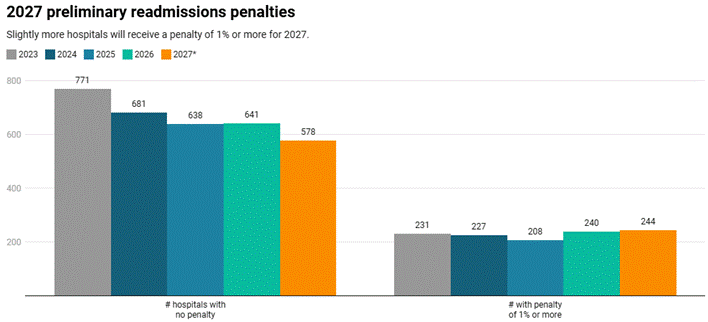
A slightly larger number of hospitals will face readmission penalties of 1% or higher in fiscal 2027, according to new data from the Centers for Medicare and Medicaid Services.
Under the Hospital Readmissions Reduction Program, 8.4% of hospitals, or 244 facilities, will see Medicare payments cut at least 1% because of excess readmissions. That compares with 8.1% for fiscal 2026. Fiscal 2027 began Oct. 1.
This marks the second consecutive year when the number of hospitals subject to larger penalties rose after dropping each year since fiscal 2022.
That means that more than 70% of hospitals, or 2,090, will be on the hook for readmission penalties below 1%, a slight decline from fiscal 2026. Nearly 20%, or 578 hospitals, face no penalties, compared with nearly 22%, or 641 hospitals, in fiscal 2026.
Source: Centers for Medicare and Medicaid Services Created with Datawrapper
The program tracks readmissions data from fee-for-service Medicare beneficiaries and, for the first time this fiscal year, Medicare Advantage enrollees. The hospital readmissions three-year performance period for fiscal 2027 penalties is based on Medicare claims from July 1, 2023, through June 30, 2025.
The Hospital Readmissions Reduction Program is a Medicare initiative that launched more than a decade ago to tackle the high costs and clinical implications of patients needing to return to the hospital to be treated for the same conditions.
For transformative EMS agencies, the message from hospitals should be clear: this is an opportunity to become part of the solution.
Health systems are increasingly investing in care navigation, virtual care, behavioral health, urgent care, and other strategies designed to keep patients with non-emergent needs out of already crowded emergency departments, efforts that have demonstrated meaningful reductions in avoidable ED utilization and costs.
EMS agencies are uniquely positioned to become valuable partners in this work through Treatment in Place, Mobile Integrated Healthcare/Community Paramedicine, telehealth-enabled field care, behavioral health navigation, and post-discharge or high-utilizer programs. Cleveland Clinic’s model is particularly instructive: emergency physicians can consult directly with paramedics in the field, order diagnostics, prescribe medications, and coordinate follow-up care.
Rather than waiting for hospitals to develop these strategies around EMS, forward-thinking agencies should be approaching their hospital partners now and asking: Which patients are unnecessarily reaching your ED, what is driving those visits, and how can we help manage those patients safely somewhere else?
As hospitals confront increasing ED demand and financial pressure, EMS has an opportunity to evolve from simply being the transportation pathway to becoming an integral part of the health system’s care-navigation strategy.
Hospitals expand push to limit ER visits ahead of Medicaid cuts By Alex Kacik October 02, 2026
“Folks who don’t have insurance, miss preventative care and come last minute to the emergency room at higher volume and higher acuity is a very big concern,” said Dr. Bryan Graham, division chair of urgent and Express Care at Cleveland Clinic.
Many people go to the emergency department even though they often could receive treatment quicker and pay less at urgent care centers and clinics. That is particularly true for mental health patients who swarmed hospital emergency rooms during the COVID-19 pandemic.
WellSpan Health is among many health systems that have worked to reduce emergency department overcrowding.
In April, the health system opened a walk-in crisis center at its community behavioral health clinic near its main hospital campus in York, Pennsylvania. This month, the health system plans to open a new behavioral health clinic in Adams County.
WellSpan opened the clinic in 2020 after receiving a federal grant for providers trying to increase mental healthcare access. The grant helped fund team-based care, where clinicians and social workers coordinate therapy, medication support and other services, said Mitchell Crawford, medical director of addiction services at WellSpan. Clinicians connect patients to social services, such as housing shelters and food pantries, helping reduce emergency department visits.
Recent results have fueled expansion plans. Roughly 3,500 patients who visited WellSpan’s behavioral health clinic last year said they would have otherwise gone to the emergency department, said Michele Crosson, project director of the Specialized Treatment and Recovery Team at WellSpan.
“We need to have strong relationships with primary care providers, outpatient facilities and community programs so there are good care transitions,” Crosson said. “Sometimes people are just lonely and need help.”
WellSpan also has tried to reroute emergency department-bound patients dealing with heart failure.
Clinicians often would send patients who called the nurse triage call center with fluid retention or shortness of breath to the emergency room. Instead, the health system set up a new symptom-based system that ranks urgency by color. A yellow-coded patient could receive a diuretic at a clinic and be sent home, for instance, said Dr. David Gasperack, chief medical officer of WellSpan Medical Group.
The system helped decrease avoidable emergency department visits by 11.2% in 2025, reducing care costs by nearly $3.4 million, he said.
Temple Health also looked to reduce heart failure-related emergency department visits when in 2020 it opened a clinic that provides wraparound care for frequent emergency department and hospital patients. The program has since expanded to all types of patients.
The clinic, located on the main hospital campus in Philadelphia, has helped reduce emergency department visits by about 40% annually, said Steven Carson, senior vice president of population health at Temple.
In August, Temple opened a second clinic about four blocks away in partnership with Fair Hill Community Physicians, a federally qualified health center.
Patients are coming to the emergency department for more than treatment, such as transportation, food, a shower and clothes, Carson said.
“We went into this naively, assuming we knew what they needed. We were wrong,” he said. “We’re now doing root-cause analysis of why each patient is coming back.”
Hartford HealthCare and Cleveland Clinic have expanded both their physical and virtual care networks as demand for care grows.
In August, Hartford HealthCare, in partnership with urgent care operator GoHealth, opened its largest urgent care center among the 50 in its network, said Jeffrey Flaks, president and CEO of Hartford HealthCare.
The new facility, which is near its main hospital campus in northern Connecticut, has treated about 30 to 40 low-acuity patients a day since it opened, he said.
Emergency department volumes already have started to slightly decline, Flaks said. “We see this as something we can do in other hospital campuses,” he said.
Cleveland Clinic started a virtual emergency medicine program in 2021 across select Ohio hospitals. The system has since expanded it to all its Ohio hospitals while also opening new urgent care locations. The program has reduced transfers from urgent and Express Care sites to emergency departments by about 30% annually, Cleveland Clinic’s Graham said.
Emergency medicine doctors can consult with patients in their hospital emergency departments or with paramedics in the field using internally designed custom Microsoft Teams software. Remote physicians can order diagnostic tests, prescribe medication and direct follow-up care.
“This is now a major part of our emergency department operations as volumes continue to rise,” Graham said.
Written by Matt Zavadsky on . Posted in Uncategorized.
This commentary is notable because it takes an issue the ambulance industry has been raising for months and places it squarely in the broader national health policy conversation.
CEPR explicitly connects restrictions on Medicaid supplemental and state-directed payments with the financial sustainability of ambulance services, warning that the consequences could include fewer staffed ambulances, longer response times, service reductions, and even agency closures.
Importantly, it also recognizes that these effects extend well beyond Medicaid beneficiaries, when an ambulance disappears from a community, it is unavailable to everyone who needs it.
The article reinforces what the profession’s own cost data have demonstrated: Medicare and Medicaid reimbursement already falls substantially short of the actual cost of providing ambulance service, leaving little capacity to absorb additional reductions.
While we may not agree with every political characterization in the commentary, having an independent economic policy organization describe EMS as potential “collateral damage” of these policies significantly broadens the audience, and strengthens the case that this is a healthcare access and community infrastructure issue, not simply an ambulance reimbursement issue.
NOTE:PWW|AG has a prepared a free toolkit that agencies can use to help assess and prepare for the potential impact of the CMS Proposed Rule impacting Medicaid Ambulance Supplemental Payment/GEMT programs.
On the 25th anniversary of the horrendous 9/11 terrorist attacks, a grateful nation is celebrating the bravery of the EMTs, emergency medical technicians who ran into fire and smoke-filled collapsing buildings to rescue and treat victims. It’s a moment to contemplate, as well, the less spectacular lifesaving rescues emergency ambulances and their crews make every day, coming to the aid of car crash victims and people suffering health emergencies in their homes.
But few of us are aware of the perilous financial situation facing emergency medical service (EMS) companies, made worse this year by provisions in H.R.1, the One Big Beautiful Bill Act, that limit how states can top up woefully inadequate Medicaid payments for services provided to people on their rolls. The number of emergency ambulances, the services EMTs provide, and the geographic areas served are in danger of being reduced, and some EMS companies have even had to close.
When President Trump signed the Republican-passed One Big Beautiful Bill Act (OBBBA) into law, there was plenty of attention paid to the more than $900 billion in cuts to Medicaid, the program that provides health insurance for low-income and disabled people. But there was little talk of the wider damage those cuts would have on health care services that millions of Americans not on Medicaid rely on.
Republicans were focused on a desperate need to offset massive tax breaks in the OBBBA for wealthy individuals and corporations that will reduce federal revenues by more than $3.5 trillion over 10 years. Republicans saw cutting Medicaid spending as an opportunity to reduce the federal budget deficit created by the tax giveaway at the expense of people they mischaracterized as illegal immigrants or able-bodied folks too lazy to work. If Mehmet Oz and others in the administration responsible for carrying out health policy knew enough to understand the fallout the bill’s provisions would create in other parts of the US health system, they raised no alarms. But it seems safe to assume that most Republicans voting for the Medicaid cuts had no idea that they would threaten emergency ambulance services and deprive Americans with no relationship to Medicaid of a quick response in an emergency.
To understand how cuts to Medicaid can threaten the nation’s emergency services, it’s necessary to take a brief detour into provider taxes and state directed payments.
State Provider Taxes
Medicaid payments to providers are often drastically below the cost of providing necessary medical services. One way that states and municipalities reduce this shortfall and retain critical services is through provider taxes that fund state-directed payments for these services. States are allowed to tax hospitals, clinics, emergency ambulance companies, nursing homes, Medicaid managed care organizations and other institutions that treat Medicaid patients and to use the proceeds to fund state directed payments to these providers to help fill the gap. Medicaid is a joint state-federal program and, like other state payments for the care of Medicaid beneficiaries, they are matched by the federal government, which picks up its share of Medicaid costs.
Prior to the passage of OBBBA, these taxes were limited to 6 percent of a provider’s net patient revenue. New provisions in OBBBA banned new provider taxes or increases in the rate of existing provider taxes.
In the states that expanded Medicaid coverage as part of the Affordable Care Act (expansion states), it ratcheted down the amount of net patient revenue that states could tax from 6 percent to 3.5 percent by 2034 with a few exceptions. This reduces the funds states have available to supplement Medicaid payments. Cutting provider taxes and state directed payments to Medicaid providers reduces federal spending on its match of these payments. These provisions are projected to reduce federal spending on matching funds by nearly $225.7 billion over 10 years.
On the state-directed payments side, OBBBA requires expansion states to reduce the size of these payments to providers to the Medicare payment rate and to 110 percent of Medicaid rates in the other 10 states by 2029. In some cases, Medicare payment rates fail to come close to covering providers’ costs. OBBBA applied these limits to hospital inpatient and outpatient services, skilled nursing facility services, and qualified practitioner services at academic medical centers. However, in May the Centers for Medicare and Medicaid Services (CMS) proposed a rule that went beyond these four categories and applied the limits to all services and providers by 2029. CMS projects its rule will reduce Medicaid spending by $775 billion over 10 years, with the federal government reaping two-thirds of the savings. In August, CMS finalized the rule extending these limits.
The Case of Emergency Services
The revenue for most EMS systems comes from billing insurers (commercial insurers, Medicare, Medicaid) and patients. The reimbursements from Medicare and Medicaid are dramatically short of covering actual costs. Much of the difference is made up from taxes (general revenue and property taxes as well as provider taxes and state-directed payments). Average payments by public insurers — Medicare (traditional fee-for-service and Medicare Advantage) and Medicaid — do not come close to covering the costs of emergency ambulance transport. Much higher payments from commercial insurers bring average revenue closer to average costs.
In December 2024, CMS released the first report on the Medicare Ground Ambulance Data Collection System (GADCS) based on an analysis by RAND Health Care. The report is based on survey data collected from 3,694 ambulance agencies for the years 2022 and 2023. It presents aggregate costs and revenues for Emergency Medical Services documenting the extent of the shortfall. The RAND report also breaks down aggregate costs into its component parts. Labor costs are the largest category. In 2022-2023, they were 69.4 percent of the $27.2 billion of aggregate ground ambulance costs for the agencies included in the survey. Labor costs include administration facilities staff as well as EMTs and EMT-paramedics. Median aggregate ground ambulance labor expenses were $551,000 while average ground ambulance labor expenses were many times larger at $3.65 million. This is likely due to a small number of EMS organizations with labor costs that were much higher than the typical organization.
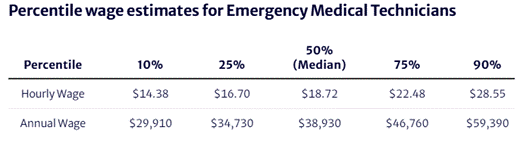
The high share of labor costs doesn’t mean that EMTs are highly paid workers, however. On the contrary, despite their skills and the stress of their jobs, their pay is quite modest. The Bureau of Labor Statistics’ (BLS) Occupation Employment Survey (OES) reports that median pay of EMTs was just $38,930 in May 2023.
A January 2025 webinar that featured the lead author of the RAND report presented average costs and reimbursements for ambulance transport and documents the gap between these costs and reimbursements to EMS agencies. RAND found that nationally, the average cost of an ambulance transport across all types of emergency medical systems was $2,673. The average reimbursement was $1,147, an under-reimbursement of $1,526 per transport. Medicare reimbursements were much lower, averaging just $329 — an underpayment of $2,334.
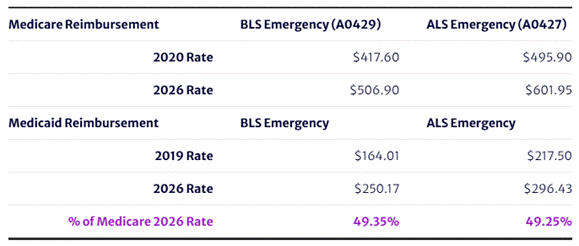
Data for New York state from the American Ambulance Association drives the disparity home. While Medicare reimbursements are higher in New York than the national average, they are still far below the costs of emergency ambulance transport. Medicare reimbursement for a basic level emergency service (BLS) was $507 in 2026 and for an advanced level emergency service (ALS) was $602. Importantly, the table below also presents Medicaid reimbursements for the two levels of emergency services: they are $250 and $296, respectively. This is just under half the Medicare reimbursement rates, a drastically low payment rate.
As the reimbursement rates show, the situation was already dire for emergency ambulance services before the development of new CMS rules in the OBBBA — rules that are even more draconian than called for in the legislation. Emergency ambulance deserts were already becoming apparent as EMS agencies closed, especially in rural and super rural areas where they are especially needed and often function as the only medical facility people can access in a medical emergency. They may become more prevalent as states’ ability to supplement Medicaid reimbursements is reduced.
Emergency ambulance services provide a sense of security in rural areas devoid of the medical resources available in cities. The limits on how states supplement Medicaid payments mean that some EMS agencies will be collateral damage as the Trump administration shreds the social safety net and cuts programs that provide essential health services that the US can well afford. Reductions in supplemental payments may lead ambulance agencies in rural areas to cut services or the number of ambulances, increasing response times when minutes may mean the difference between life and death. Emergency ambulance services may even find that they can’t make the math work and close down.
JD Vance, who cast the deciding vote for the OBBBA, ignored the effects of cuts to Medicaid on health care for the many folks in Appalachia and elsewhere who rely on the program. But he probably didn’t consider the effect of the cuts on the wealthy people with second and third homes in remote scenic areas. These people, too, may find there isn’t an ambulance with a crew of EMTs available to stabilize them after a traumatic event.
Written by Matt Zavadsky on . Posted in Uncategorized.
Interesting ED wait time data from CMS, which could be used by innovative EMS systems to help make the case for funding and implementing alternate disposition models such as:
Dispatch Triage: With ED visits averaging more than 2½ hours, EMS should expand clinical dispatch triage and secondary nurse/clinician review to identify patients who may not need an ambulance or ED. The best opportunity to avoid an unnecessary ED visit may be before the ambulance is ever dispatched.
Treatment in Place & Alternative Destinations: ED overcrowding strengthens the case for treatment in place, telehealth, and transport to appropriate non-ED destinations. Every safely avoided ED transport reduces demand on an already-congested system while potentially giving the patient a better care experience.
Mobile Integrated Healthcare: As patients delay routine care and increasingly reach crisis points, MIH can intervene upstream through high-utilizer management, post-discharge follow-up, and care navigation. The most valuable EMS response may be the 911 call and ED visit that never have to happen.
Patients now spend an average of more than two and a half hours in hospital emergency departments, and visits have been getting longer in nearly half of the states, new federal data shows.
Why it matters: Forthcoming insurance eligibility and cost changes could lead people to put off care until their health reaches a crisis point, sending even more patients to an ED.
Longer visits may also mean longer waits to see a clinician — a driver of negative experiences and increased costs for the health care system.
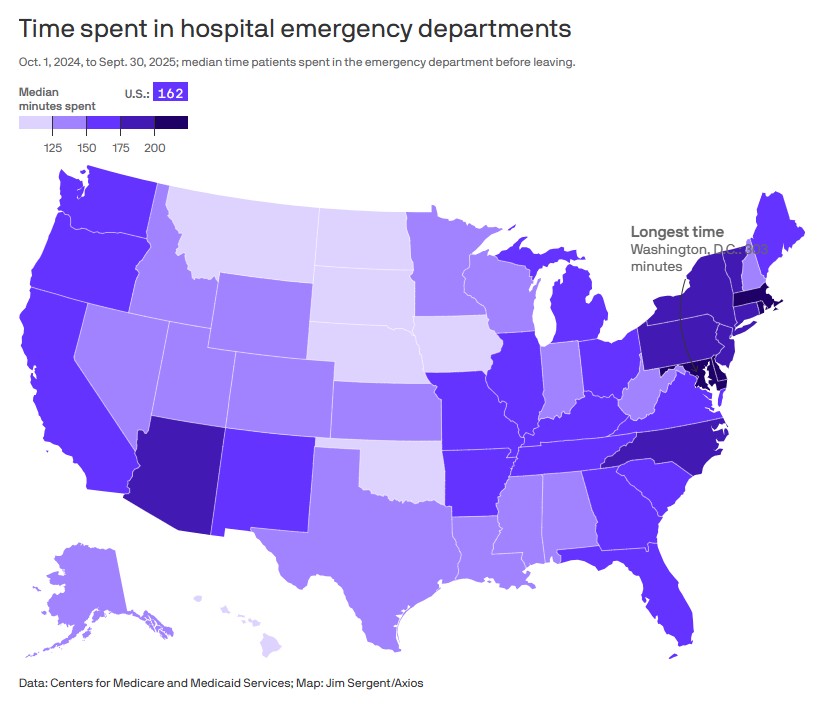
Driving the news: The median time spent in the emergency department was 162 minutes during the year ending Sept. 30, 2025, according to the Centers for Medicare and Medicaid Services.
Washington, D.C., had the highest median visit length at 303 minutes. North Dakota had the lowest, at 110 minutes. The national median visit length stayed the same from the previous year.
The data also shows that an average of 2% of patients nationwide left the emergency department before being seen.
Median visit lengths increased in 24 states and D.C. compared with the prior 12-month period, per Axios’ analysis of the CMS data.
Oregon and Arkansas each saw a 15-minute jump in visit times. Twenty states saw decreases.
Between the lines: More than 20% of patients spend more time waiting for an ED visit than recommended for their triage level, according to the most recent data from the Centers for Disease Control and Prevention.
Reducing ED wait times is one focus in a federal effort to improve health care by 2030.
Zoom out: Once patients are seen in the ED, they can face more long waits before they’re actually admitted to the hospital.
The vast majority of emergency departments report overcrowding, and nearly a quarter of people requiring inpatient care have to wait at least four hours for a bed to open up, according to a study published last week in JAMA.
The Agency for Healthcare Research and Quality convened a summit in 2024 to address what happens to patients who are sick enough to require inpatient care.
But the health services research agency has been gutted since the Trump administration took office last year, and the Department of Health and Human Services didn’t respond when asked if the emergency room improvement work is continuing.
The big picture: Hospitals are facing a perfect storm of changes that could make it hard to focus on emergency visit and wait times, including Medicaid funding cuts, scrutiny of the federal discount drug purchasing program and a shift toward site-neutral hospital payments.
“Beneath the surface of longer emergency department wait times, there will be a range of impacts from delays in accessing care to a loss of services,” Beth Feldpush, senior vice president of advocacy and policy at America’s Essential Hospitals, told Axios.
What we’re watching: AI-powered technologies have already started to help lower emergency room wait times, a 2025 review found.
But data quality issues, biased algorithms and ethical concerns could make it hard for emergency rooms to adopt the technologies widely.
Written by Matt Zavadsky on . Posted in Uncategorized.
Stakeholders should be cautious when using the term “Essential Service” designation.
Designation of emergency medical services (EMS) as an “essential service” is important because it recognizes a basic public policy reality: communities depend on EMS for immediate access to lifesaving medical care, just as they depend on other core public-safety services. But the term essential service can mean very different things in state law, and that distinction is critical when evaluating the practical value of an essential-service designation.
The CO passed legislation is essentially a proclamation that the legislature appreciates EMS. Like the majority of other states that ‘state’ EMS is an essential service, it DOES NOT require local jurisdictions to assure EMS IS provided in their jurisdiction.
A recent review of state “EMS Essential Service” laws by PWW Advisory Group (PWW|AG) reveals that many states have enacted statutes or resolutions recognizing EMS as “essential,” “vital,” or important to public health and safety without actually imposing an obligation on local government to ensure that EMS is available or financially sustainable. For example, Alabama declares EMS to be an essential public service performed for a public purpose, while Colorado describes EMS as an essential service and an integral part of the state’s healthcare infrastructure. Neither, however, requires local jurisdictions to provide or fund EMS. Similarly, Maine recognizes EMS as essential to a well-functioning health system, and Nebraska calls EMS an essential healthcare service that can mean the difference between life and death or permanent disability, but neither designation creates a local obligation to provide or fund the service.
Of the 22 states that have passed ‘essential service’ designation for EMS, only 7 (HI, NC, PA, SC, TN, UT and WV) require that jurisdiction assure EMS is provided in their jurisdiction.
For example, here’s the language in the TN “Essential Service” legislation:
“(a) Ambulance service is hereby designated as an essential service in the state of Tennessee. (b) All county governing bodies are authorized and directed to make provisions to ensure that at least one (1) licensed ambulance service is available within their county. This may be provided as a county service, but can also be accomplished through other means, including, but not limited to: providing a license or franchise to a private company; contracting with a public, private, or nonprofit entity for the service; entering into an interlocal agreement with one (1) or more local governments; or entering into an agreement with a hospital or other healthcare facility. A county is not required to appropriate county revenues for ambulance service if the service can be provided by any other means.”
Click here for an updated chart, with source links, to a summary of “EMS as an Essential Service” legislation.
Colo. law recognizing EMS as an essential service goes into effect
HB 26-1238 covers ambulance and air ambulance services while clarifying that off-duty EMS providers are not required to respond
Written by Matt Zavadsky on . Posted in Uncategorized.
Ambulance agencies and advocacy associations should pay close attention to the renewed congressional interest in revisiting the No Surprises Act.
If insurers and employers succeed in opening the law for legislative changes, they may also see an opportunity to press Congress to finally address ground ambulance balance billing, potentially including a federally mandated payment methodology, or adding ground ambulance to the current NSA. That could have significant reimbursement implications for ambulance providers.
As we know, the insurance industry has been very active recently in state-level statutes, in some cases, successfully proposing language in the statutes that cap commercial reimbursement for ambulance service at 180% – 200% of the Medicare Ambulance Fee Schedule.
A summary of the current state patient protection/balance billing laws prepared by PWW|AG can be found here.
We should therefore be at the table early, advocating that any ground ambulance solution establishes fair, sustainable reimbursement rather than simply extending existing surprise-billing restrictions to ambulance services.
In Washington, reopening a major healthcare law can create opportunity, but it also creates risk for stakeholders who are not actively engaged in shaping the outcome.
Lobbying cranks up for another surprise billing fix
Providers and insurers are so divided over the process for resolving surprise billing disputes that they can’t even agree on the true size of the payouts. And the blame game is likely to continue into next year.
The big picture: The continued sparring four and a half years after a federal surprise billing law took effect is fueling fresh calls for another congressional “fix” to address a staggering backlog of cases and questions, like which disputed items and services can be lumped together.
“There’s been a change in the dynamic from even a few weeks ago,” said Jack Hoadley, research professor emeritus at Georgetown’s Health Policy Institute.
Driving the news: Insurers this summer have intensified calls to overhaul the independent dispute resolution process, saying it routinely awards providers big payouts that drive up the cost of care.
Their arguments were boosted by a Wall Street Journal report on federal data that found the process awarded nearly $15 billion to providers last year — more than triple the total for 2024.
The Trump administration issued a final rule in May aimed at streamlining arbitration, though some policy analysts predict the changes will only encourage more practices to take claims to arbitration. Insurers and employers both are pressing for more.
“Action is needed to protect consumers and employers from indefensible and well-documented price gouging by some out-of-network providers and arbitration middlemen who flood the system with ineligible claims to extract exorbitant payments,” said Mike Tuffin, president and CEO of the insurer trade group AHIP.
The other side: Providers say as much as $2.7 billion of the payouts the Wall Street Journal cited appear to be incorrect, and blame the flawed data for contributing to the perception that doctors are gaming the system.
They point to insurers not engaging meaningfully in the negotiation process by refusing to pay more than 1 million disputed claims or offering rates of less than $1 for some services.
“If we keep winning, why aren’t insurers coming back to the table with a more reasonable offer?” said American College of Emergency Physicians President Tony Cirillo.
The general idea was that if either side began to lose too often, it would ultimately change behavior. “And it hasn’t changed,” Cirillo said.
What we’re watching: There’s bipartisan traction for a legislative fix, possibly including penalties for submitting ineligible claims and prompt pay for providers — but it likely won’t happen this year, TD Cowen analyst Molly Turco wrote in a recent note.
The urgency could intensify if big insurers cite the arbitration process as a drag on their earnings. UnitedHealthcare criticized the process in its second-quarter earnings call, saying it’s one of the reasons commercial insurance rates remain elevated.
A federal appeals court on Tuesday partially sided with a Texas medical group’s challenge to certain criteria used in the arbitration process, which could also increase pressure for Congress to weigh in.
Written by Matt Zavadsky on . Posted in Uncategorized.
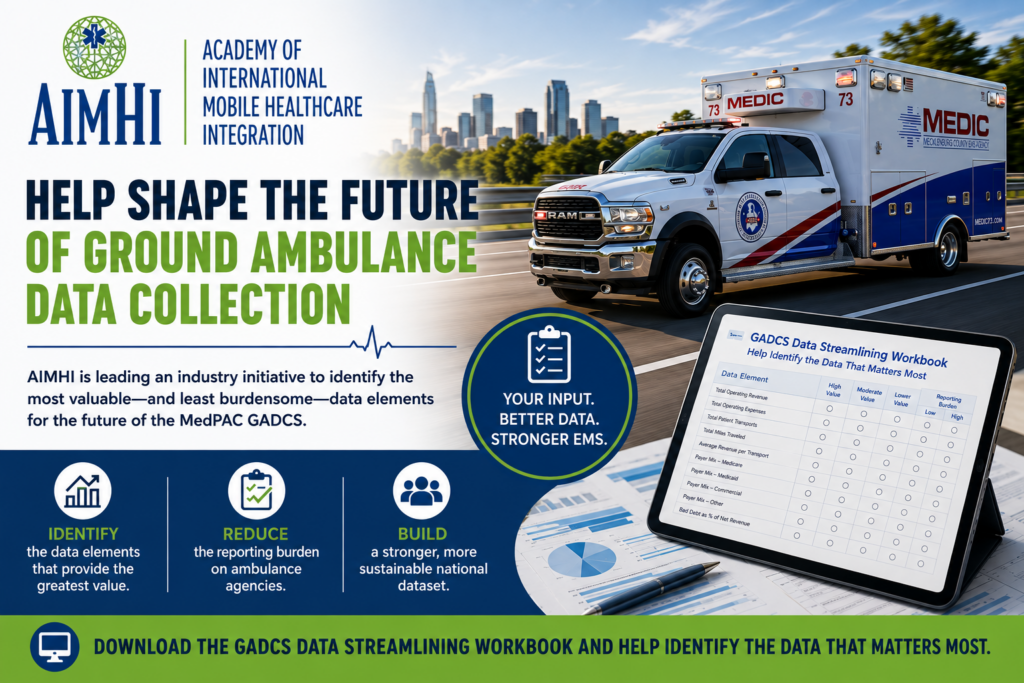
AIMHI Launches Initiative to Identify the Most Valuable – and Least Burdensome – GADCS Data Elements
The Academy of International Mobile Healthcare Integration (AIMHI) is inviting ambulance agencies across the country to participate in an important initiative aimed at helping shape the future of the Medicare Ground Ambulance Data Collection System (GADCS).
Following the release of MedPAC’s recent report analyzing the first several years of GADCS data, AIMHI representatives met with MedPAC staff to discuss the current data collection process, the value of the information being collected, and opportunities to reduce the significant reporting burden placed on ambulance service providers.
One concept discussed was whether MedPAC and policymakers could obtain the information they need through a smaller, more focused set of high-value data elements, potentially collected more frequently from a rotating sample of ambulance agencies.
Such an approach could provide policymakers with more timely information about the economics of ambulance service delivery while substantially reducing the amount of information individual agencies are required to collect, calculate, validate, and report.
Now We Need the EMS Community’s Help
To help evaluate this concept, AIMHI has developed the GADCS Data Streamlining Workbook, which contains the current GADCS data elements and allows ambulance agencies to help identify which elements should be considered essential to a more streamlined data collection process.
We are asking ambulance agencies of all types, sizes, service models, and geographic settings to review the workbook and identify approximately 25–50 data elements, excluding basic agency demographic information, that meet three important criteria:
Value: The information is important for understanding the true costs, revenues, utilization, and economics of providing ambulance services.
Accessibility: The information can reasonably be obtained from data agencies already collect or maintain.
Sustainability: The data element could realistically be included in a streamlined reporting process without creating unnecessary administrative burden.
This is an expert opinion survey. Agencies are not being asked to compile operational or financial data, only to evaluate which GADCS data elements are most valuable and practical for future national reporting.
The goal is to identify the data that policymakers truly need, and that ambulance agencies can reasonably provide, to create a credible, sustainable national picture of ambulance service costs and revenues.
Most agencies should be able to complete this review in approximately 60 minutes.
Why This Matters
GADCS data are increasingly influencing federal discussions about ambulance reimbursement, the adequacy of Medicare payments, and the financial sustainability of EMS systems.
That makes the quality of the data critically important.
But more data does not necessarily mean better data.
A smaller number of well-defined, consistently reported data elements may ultimately provide policymakers with better and more timely information than an extensive data collection process that requires significant agency resources and occurs only periodically.
AIMHI has also encouraged MedPAC to conduct a similar exercise internally by identifying the data elements it considers most important to its analyses. Comparing MedPAC’s priorities with those identified by ambulance providers could help establish a core national ambulance dataset that balances policymaker needs with provider reporting burden.
Help Us Build the Recommendation
Once responses are received, AIMHI will aggregate the results and identify the data elements receiving the strongest support from ambulance agencies.
AIMHI also intends to share the findings with national EMS organizations and explore opportunities to collaboratively develop recommendations regarding the future of ground ambulance data collection.
A broad, consensus-based recommendation from the EMS community has the potential to carry considerably more weight than individual organizations or agencies approaching this issue independently.
This is an opportunity for ambulance agencies to help shape the future of GADCS.
We encourage ambulance leaders, finance professionals, reimbursement specialists, data analysts, and others familiar with their agency’s GADCS reporting experience to complete the AIMHI GADCS Data Streamlining Workbook and add their perspective to this important national conversation.
Download the GADCS Data Streamlining Workbook and help identify the data that matters most.
Written by Matt Zavadsky on . Posted in Uncategorized.
Here’s a great example of a quality dispatch triage systems effectively managing low-acuity 911 “EMS” requests.
Article Themes:
Dispatch-based clinical triage is safely reducing unnecessary ambulance responses.
Advanced care paramedics use structured clinical assessment through Priority Solutions, Inc.’s Emergency Communications Nurse System to match patients with the right resource.
Long-term follow-up and prevention are central to the model.
Dispatch paramedics refer 40 per cent of reviewed 911 calls to alternative options
Advanced care paramedics working in Alberta’s emergency dispatch centres referred 40 per cent of close to 6,000 reviewed 911 calls to alternative care options after a new clinical triage model launched May 26, Emergency Health Services Alberta says.
The reviewed calls represented 8.9 per cent of what the agency described as “all 911 demand.”
The July 13 release did not define the geographic scope or precise reporting cutoff for that percentage beyond saying the calls had been reviewed since the program launched.
EHS Alberta also did not provide regional figures, patient-outcome data or before-and-after figures for ambulance response times and emergency department transportation.
How calls are assessed
Following the initial handling of a 911 call, advanced care paramedics may be connected with lower-acuity callers to conduct a more detailed assessment.
The paramedics are stationed in Alberta’s Central Communications Centre and Southern Communications Centre.
They use the Emergency Communication Nurse System, which EHS Alberta describes as a structured clinical assessment tool for triaging low-acuity patients.
The agency said alternatives offered through the program included self-care advice, primary-care referrals, Mobile Integrated Healthcare, taxi transportation and alternative response vehicles.
The remaining 60 per cent of reviewed calls received an ambulance response when clinically appropriate, according to the release.
EHS Alberta did not provide a breakdown showing how many calls were referred to each option or how many were closed without an ambulance being dispatched.
“Our paramedics in dispatch provide self-care advice and reassurance to callers while confirming clinical acuity and priority, ensuring patients who do require EMS receive an appropriate response,” Les Fisher, managing director and chief of EHS Alberta, said in the release.
“Safely identifying cases that can be closed without ambulance dispatch helps keep ambulances available for when they are truly needed.”
Model based on other jurisdictions
EHS Alberta said its model is based on programs used in Saskatchewan, Niagara Region, Wales and New Zealand.
The agency said emergency response vehicles will always be available for patients with high-acuity needs.
Patients with unknown or suspected high-acuity conditions will continue to be transported by ambulance, according to the release.
EHS Alberta said the model is part of efforts to improve response times, reduce unnecessary transportation to emergency departments, improve patient flow and strengthen emergency health services.
The release did not provide figures showing whether those measures have changed since the model began.
EHS Alberta oversees air and ground ambulance services, interfacility transfers and dispatch operations, including services delivered by contracted partners.
When a 911 dispatcher answers a call, traditionally the request for resources goes to the Police Department or the Fire Department.
With their Community Alternative Response Emergency Services (CARES) team, the Madison Fire Department (MFD) takes a different approach, according to Assistant Fire Chief Chris Hammes.
Since 2021, MFD, Journey Mental Health and Public Health Madison and Dane County have collaborated on CARES. Since then, CARES has served as an alternative to police to respond to emergency and crisis calls for individuals experiencing “behavioral emergencies that are nonviolent in nature.”
CARES allows for a third resource for people in crisis, because many people who call 911 will not benefit from the emergency room or jail, said Hammes. It is important to give that individual the care that best suits their circumstances. Individuals in need may access CARES through a crisis line or through 911 calls.
Over the past five years, MFD CARES has responded to over 14,000 calls and 8,500 individuals, including some repeat patients and some who refuse help.
Of the more than 8,500 individuals that CARES has helped, 60% had their crisis mitigated, with 25% transported to a second location – a detox home, a shelter, a hospital – and only 2% have been incarcerated.
“There’s a lot of other alternatives that we have in our community that CARES is really plugged into, and can align individuals up with those resources,” said Hammes.
Each CARES team consists of a community paramedic and a crisis worker. Paramedic expertise allows for the team to best assess the safety of the patient and call for an ambulance if necessary. The crisis worker creates a care plan that gives individuals access to a variety of resources.
CARES gives their patients access to case management, behavioral health services,, housing and shelter services, care center, groups homes, rehab resources, ageing and disability resource centers and more, said Hammes.
“Some individuals that are having these emergencies, they sometimes recognize some of these same CARES team members that arrived,” he said. “That, inherently in itself, maybe brings down that level of anxiety; it just helps deescalate things with a little bit of familiarity. If someone has helped you out in the past, they might be able to help you out in this situation again, right?”
Knowing patients not only helps the situation but the overall care plan, said Hammes. The team can follow up on prior plans, asking if they have worked on what the team suggested, and see if there is another component of life they are struggling with, said Hammes.
Community paramedic is about “having the awareness of what they should be looking for with injury prevention.” It is taking the time to help implement even small changes that could help a living situation, according to Hammes.
When not responding to calls, the CARES team works on referrals that help implement these small changes, said Hammes. Maybe it’s a handrail down a set of stairs an individual has repeatedly fallen on or a pill organizer for a patient who frequently forgets to take their medication, said Hammes.
“Once it’s identified that someone out there is struggling with some component of living in the environment that they’re in. If there’s something we can do to tweak that, that’s what our community paramedics get to and really try to center on,” said Hammes
“So we can prevent a bad thing from happening, prevent that next fall which might cause a hip fracture or a head injury that really then puts them in a debilitative state.”
This mitigation from emergency rooms and jails not only relieves strain there but also strain on EMS in general, said Hammes.
“But most importantly, it’s a win for that patient who best benefits from the resources that these care teams can plug them into. That’s going to help them through their event that they’re through. Such a phenomenally successful program that we’re really proud of.”
As trust and need expand, CARES responds to more and more calls, said Hammes. In 2024 they expanded to three full-time teams. In 2025, a pilot program was deployed in Sun Prairie.
“If we get a continued increase of call requests and calls, it’s going to be our challenge to try to meet the need for that demand of service there,” said Hammes.